Industry surveys show the share of organizations with AI models in production has crossed the majority threshold. Yet less than a third of teams report having reliable mechanisms for tracking output quality, latency drift, or hallucination rates once the model is deployed. The next maturity frontier is observability — production-grade oversight over prompts, responses, and cost.
Why monitoring is not observability
Monitoring tells you whether a system is up or down and reports predefined metrics. Observability lets you ask questions you did not anticipate: why did this prompt fail, how did cost spike at 2 p.m., or when did the model start hallucinating on a specific topic. For AI in production, observability is the difference between reacting and understanding.
The three signals that matter for AI in production
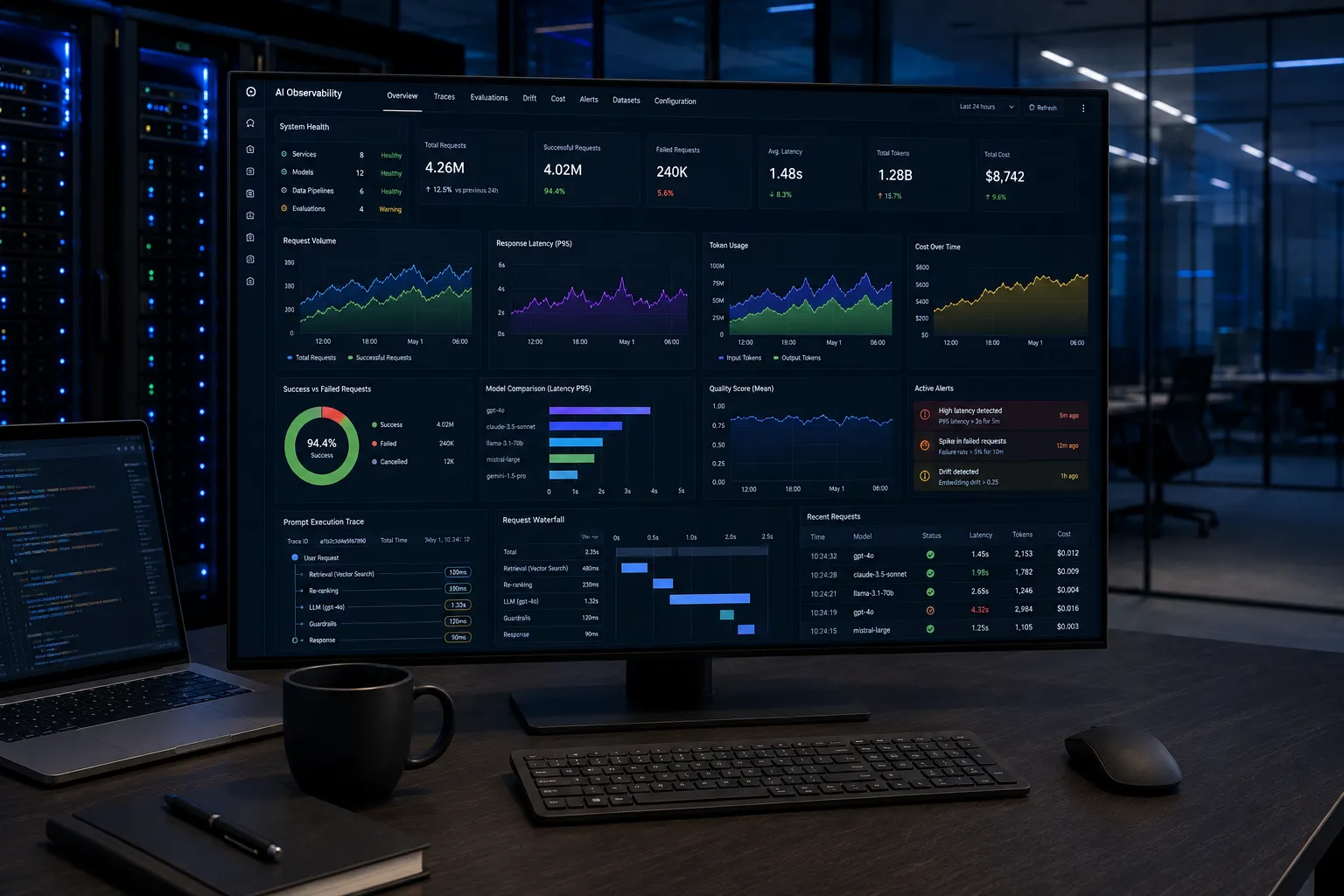
Output quality — tracking hallucination rates, response relevance, and factual accuracy over time. Latency and cost — measuring token usage, API round-trip time, and model selection efficiency per request. Data drift — detecting when input distribution shifts degrade model performance, especially for RAG and fine-tuned models.
"An AI system that works perfectly in preview but has zero production observability is not a product; it is an experiment with an SLA."
From proof of concept to governed production
The path from prototype to production runs through logging, tracing, and evaluation pipelines. Teams that instrument their AI stack early — capturing prompts, completions, embeddings, and guardrail results — can detect issues before users do and continuously improve output quality.
The 2026 enterprise observability stack
LLM proxies with tracing, embedding drift detectors, response quality scorers, and cost dashboards are maturing from startup tools to enterprise-grade platforms. Combined with existing APM infrastructure, they give AI teams the same level of operational confidence that platform teams expect from traditional microservices.
How DELRIQUE helps
DELRIQUE Labs builds and researches operational AI infrastructure: production-grade observability pipelines, prompt management, evaluation frameworks, and cost governance — designed to run securely inside your perimeter.
Explore DELRIQUE LabsFrequently asked questions
Do I need observability if my AI system is internal?
Yes. Internal tools still experience quality drift, produce incorrect answers, and consume budget. Observability gives the team the data to justify continued investment or request model changes.
How is AI observability different from using APM tools?
APM tools monitor infrastructure; AI observability tools monitor specific AI behaviors like evaluation of output quality, prompt drift, and token economics from a model perspective. Both are needed.
What is the simplest observability setup we can start with?
Log every request and response in a structured format, then evaluate a sample for relevance and accuracy. This alone reveals patterns you will want to amplify or suppress.
Does self-hosting affect observability?
It improves it. You own the logs, traces, and prompts — zero third-party exposure and full audit compatibility. The observability stack itself should follow the same data sovereignty principles as the model server.